
"Côte d'Ivoire coffee facts"
50 article(s) found

How coffee trees in C ô te d'Ivoire (C ô te d'Ivoire te d'ivoire) taste coffee
As long as it is delicious coffee, coffee consumers are willing to pay a high price; as long as delicious coffee is provided, consumers will not abandon coffee and the market will grow. High-quality coffee represented by boutique coffee is better than big business coffee producers and consumers have discovered this simple fact. In recent years, coffee producing countries no longer blindly pursue high output while neglecting quality.

Coffee that the French like
I have heard that France once drank less coffee because of a shortage of coffee, and immediately saw more people taking a nap. It may seem like an exaggeration, but it is true that the French are addicted to coffee. When the Gulf War broke out in 1991, France was also one of the countries participating in the war. some ordinary people in China worried that the war would affect the supply of daily necessities and rushed to supermarkets to buy them. Even the TV station was alarmed when the camera was in front of it.

The coffee environment and atmosphere that the French like most care about.
I have heard that France once drank less coffee because of a shortage of coffee, and immediately saw more people taking a nap. It may seem like an exaggeration, but it is true that the French are addicted to coffee. When the Gulf War broke out in 1991, France was also one of the countries participating in the war. some ordinary people in China worried that the war would affect the supply of daily necessities and rushed to supermarkets to buy them. Even the TV station was alarmed when the camera was in front of it.

The basic knowledge of coffee beans the origin of the species of coffee beans
West Africa, the origin of coffee grown in Liberia, has a strong adaptability to all kinds of environments, such as high or low temperature, humidity or dryness, except that it is not resistant to leaf rust and its flavor is worse than that of Arabica, so it is only traded or planted in some West African countries (Libya, C ô te d'Ivoire, etc.). Among the coffee in circulation in the world market, about

Introduction of coffee beans introduction to the taste of boutique coffee
、. The Robusta species (scientific name Coffea robusta Linden) is a leaf rust-resistant variety found in the African Congo, which teaches the Arabica species to be more resistant to the disease. People like to compare robusta with Arabica coffee. In fact, robusta is a mutant of Congo (scientific name Cofffea canephora), so it should be compared with Arabica.

What are the three primary coffee species?
Liberian: West Africa is the origin of Liberian coffee. It has strong adaptability to various environments such as high temperature or low temperature, humidity or dryness, etc., except for leaf rust resistance, and its flavor is worse than Arabica, so it is only traded domestically in some West African countries (Libya, Cote d'Ivoire, etc.) or planted for research. circulating in world markets

Three Coffee categories and Seven Coffee producing areas-how many Coffee producing countries in the World
Robusta: a leaf rust-resistant variety found in Congo, Africa, that is more resistant than Arabica. In fact, the Robusta species was originally a mutant of the Congolese species. Arabica coffee beans grow in the cold tropical high-sea areas, and the high-temperature and humid zone that is not suitable for Arabica coffee is where Robsta coffee grows. The Robusta species is generally used

Boutique Coffee introduction of 53 Coffee producing areas in the World 4
twenty-three. Angola, once a big coffee producer, exported 3.5 million bags of coffee a year in the mid-1970s, 98 per cent of which was Roberts (probably the best in Africa), but total production fell to 200000 bags in 1990. The best brands in Angola used to be Ambriz and Amborm.

The three native species of coffee, the main varieties of Colombian coffee.
Varieties resistant to leaf rust found in Congo, Africa, teach Arabica species to be more resistant to the disease. People like to compare the robusta species to the Arabica species of coffee. In fact, the robusta species was originally a mutant of the Congolese species (scientific name Cofffea canephora), so it is the Congolese species that should be compared with the Arabica species. To this day, however, Robusta species

Introduction to the flavor and taste of Arabica coffee manor in Indonesia
Varieties resistant to leaf rust found in Congo, Africa, teach Arabica species to be more resistant to the disease. People like to compare the robusta species to the Arabica species of coffee. In fact, the robusta species was originally a mutant of the Congolese species (scientific name Cofffea canephora), so it is the Congolese species that should be compared with the Arabica species. To this day, however, Robusta species

A brief introduction to the history and culture of the origin and development of Arabica coffee in Indonesia
Even if the coffee has the same name (named from the place of origin), as long as the cultivated varieties are different, the flavor is different from the leaf rust-resistant varieties found in the African Congo, teaching the Arabica species to be more resistant to the disease. People like to compare robusta species with Arabica coffee. In fact, robusta species is originally a mutant of Congo species (scientific name Cofffea canephora), so it is said that

Arabica coffee beans are black coffee beans.
Professional coffee knowledge exchange More coffee bean information Please pay attention to coffee workshop (Weixin Official Accounts cafe_style) Front Street-Introduction of three coffee bean varieties Arabica-Arabica Arabica has excellent flavor, but its yield is low and it is not resistant to diseases and pests. It has high requirements for planting conditions such as climate and soil. Generally, fine coffee is Arabica. Arabica's origin is high in Ethiopia
Basic knowledge about coffee
What is coffee? Coffee is the fruit of a Rubiaceae plant grown at altitudes of about 6,000 feet and distributed along narrow subtropical axes around the world; the coffee tree is green all year round and can grow up to 20 feet tall, usually controlled to 8 to 10 feet tall for easy harvesting.

The basics of coffee cultivation
What is coffee? Coffee is the fruit of a Rubiaceae plant growing about 6000 feet above sea level, distributed on the world's narrow subtropical axis; coffee trees grow green all the year round and can grow up to 20 feet tall, and are generally controlled at 8 to 10 feet for easy harvest.
Basic knowledge of coffee growing
What is coffee? Coffee is the fruit of a Rubiaceae plant grown at altitudes of about 6,000 feet and distributed along narrow subtropical axes around the world; the coffee tree is green all year round and can grow up to 20 feet tall, usually controlled to 8 to 10 feet tall for easy harvesting.
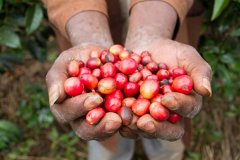
Three native species of coffee: Arabica, Robusta and Liberia
Coffee belongs to the evergreen shrub of the genus Rubiaceae, which is centered in the tropics. There are about 6000 species of Rubiaceae belonging to 500 genera. Coffee has always been considered to have certain effects, such as invigorating the stomach, waking up the brain, stopping bleeding, dissipating heat, strengthening the body and so on. There are about 40 species of coffee plants, but the only ones that can produce coffee beans of commercial value are Arabica, Robusta and Libby.
Introduction to the characteristics of the three native species of coffee is the superiority of Arabica coffee beans so high?
Professional coffee knowledge exchange more coffee bean information please follow the coffee workshop (Wechat official account cafe_style) front street-three major coffee varieties there are about 40 species of coffee, but can produce commercial value coffee beans only Arabica species, Robusta species, Liberia species, these three are called the three major native species of coffee. The origin of Arabica species is Ethiopia.

Panama Estate Coffee Beans
Arabica species originated in Ethiopia's Abyssinia Plateau (now Ethiopia Plateau). It was mainly eaten as medicine in the early stage (Islamic couples used it as a secret medicine for physical and mental treatment or to wake up). In the 13th century, it cultivated the habit of baking and drinking. In the 16th century, it was introduced into Europe via Arabia, and then became a favorite drink of people all over the world.

The difference between the three native species of coffee and the introduction of Arabica and Robusta
Coffee belongs to the evergreen shrub of the genus Rubiaceae, which is centered in the tropics. There are about 6000 species of Rubiaceae belonging to 500 genera. Coffee has always been considered to have certain effects, such as invigorating the stomach, waking up the brain, stopping bleeding, dissipating heat, strengthening the body and so on. There are about 40 species of coffee plants, but the only ones that can produce coffee beans of commercial value are Arabica, Robusta and Libby.
A brief introduction to the characteristics of the three native species of coffee beans Blue Mountain coffee beans belong to Arabica coffee
Professional coffee knowledge exchange more coffee bean information please follow the coffee workshop (Wechat official account cafe_style) front street-three major coffee varieties Arabica coffee plant is usually not tall, slightly slender green leaves, smaller oval fruit, also known as small seed coffee. With outstanding flavor, charming aroma and clear fruit acid, the shape of beans is uneven, Zhongyang line